
It Came from the Midwestern Corn Fields and Strip Malls
A Blaster bio.

EDIT (4 Dec 2025): I added in a handful of both christian bands and local Indianapolis bands in the influences section. It was an oversight not to include them in the first draft. I also added in a little more on the music of SSFFTV as the first draft was a little too lyric-heavy in summary. I also added a few critical notes on TMAJ.
The following is adapted from the ‘long bio’ that Audiofeed asked for for their promotional materials. Kinda fun to write about it in third person. Bit of self-mythologizing no doubt. But one thing that fascinated me in writing it was to recall and shout out how many other bands Blaster overlapped with in its various member lineups. This kind of stuff is really for others to write (if at all). I’m mostly going to write about the ‘inside feel’ of our history rather than a bunch of facts and figures. But this gets us started! Feel free to add details and/or corrections in the comments!
Bio:
Born from East Side Indianapolis and its surrounding flatlands of cows, corn, and strip malls, Blaster The Rocket Boy (later Man) was the unholy brainchild of Dan and Dave Petersen (aka Otto Bot and Heater Hands). These working-class pastor’s kids got hooked on punk and rock n roll from an early age. (In fact, their dad, the Rev. O. J. Petersen, had himself been a 50s rocker in the navy and later a 60s/70s Jesus Rocker in southern California.)
Dave, seven years younger than Dan, started learning drums at age 9 and had joined Blaster by age 13 after he filled in at a practice and everyone thought: this kid can play! Dave soon learned the early Blaster songs on guitar and bass by watching the other band members play and would go on to write the majority of the music on the albums. While sharing his older brother’s love for punk, Dave also always nudged the band into wider musical explorations in rock music and various regional genres.
Dan, for his part, was inspired especially by two Mikes (Knott and Patton) to put on his homegrown version of their theatrical, energetic, and slightly unhinged live performances as frontmen. His early vocal influences were a patchwork of, on the one hand, standards of early U.S. rock n roll (Elvis, Buddy Holly, Chuck Berry) and early U.S. punk (Ramones, Misfits, Cramps, Dickies, Minor Threat).1 On the other hand, the brothers were also influenced by the peculiarities of local Indianapolis bands like Scary Tweezers, Modern Vending, and Sloppy Seconds, as well as 80s/90s christian indie/punk bands such as Lifsavers Underground (LSU), Scaterd Few, Nobody Special, Crucified, Breakfast with Amy, and Fluffy. Given that Dan’s vocals were more the stuff of enthusiasm than ability and that his earliest influences also included Universal Monsters and other classic horror cinema, friends of the band perhaps said it best when they remarked that his singing sounded like a movie mad scientist meets a movie vampire.
After a short-lived lineup consisting of members of fellow Indy band Three Nails, Dave and Dan were joined by Evansville scene kids Chris Dickens (Flimzy) and Mike Schauss (Indoor Plants) on guitar and bass respectively.
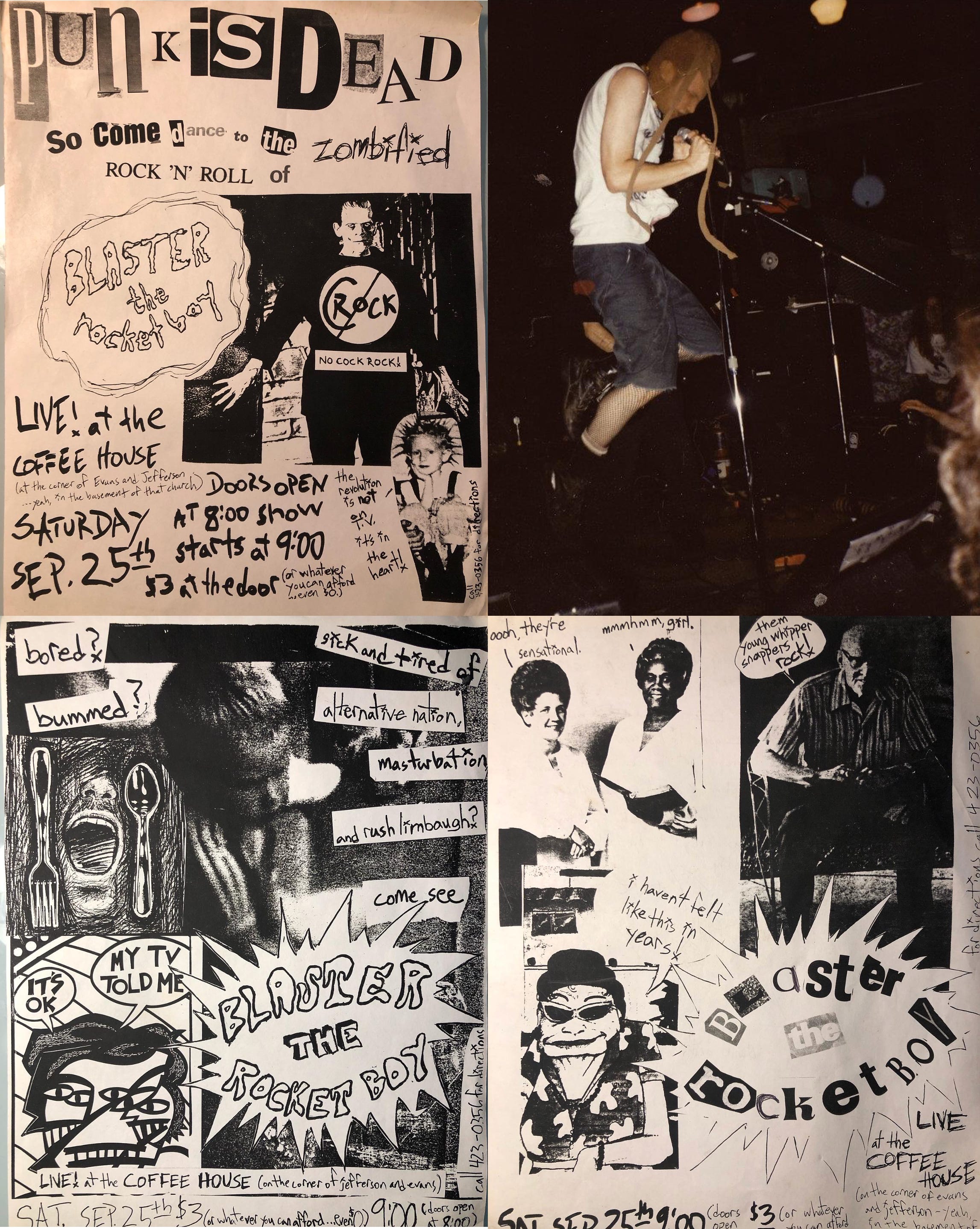
This formed the core band that Caleb Olsen signed to Boot to Head records for the first two albums, Disasteroid (1995) and Succulent Space Food For Teething Vampires (1997, known as SSFFTV). The first album was recorded in one day and the second in two weekends, both in Dongola, Illinois by Josh Plemon of Clay/S.S. Bountyhunter. Inclusion of the Disasteroid version of “I’m Only Humanoid” on Tooth & Nail’s I’m Your Biggest Fan Vol. 1 compilation (1996), plus annual appearances at Cornerstone Festival, garnered wider awareness of the band.
The lyrics on these albums ranged from religious allegories about the blood of Christ for vampires and werewolves to mentions of Godzilla, X-Men, Star Wars, Voltron, time machines, robots, flesheaters, hounds of hell, man-eating plants, and more. The music was heavily influenced by ‘old school’ punk and elements of noise rock, surf, and rockabilly, with notes here and there of darker, crustier, or grindier expressions—and not a little silliness and fun in both vocals and instrumentation for counterbalance (or unsettling juxtaposition). Some have noted that the songs often follow a sort of ‘movement’ structure, notably with a third act that shifts both musically and lyrically (the latter often making explicit the christian allegory).
The band’s lyrics, style, and live shows made a lasting, if small, impression in the underground scenes, mostly Christian but some non-Christian as well. Lots of gigging in the Midwest (inclusive of Otto’s “preaching” mid set) eventually led to shows further afield and a two-week tour through the South in 1998, with Mike switching to guitar (after Chris left) and Jason Allender joining on bass. Mike and Jason also eventually left the band and Elijah Sheridan (aka Oxford Don) took up bass (with his famous pink Warlock).
At this point Blaster The Rocket Man (as they now called themselves) were persuaded by Matt Wignall (Havalina Rail Co.) to move to his new record label Jackson/Rubio for their final album The Monster Who Ate Jesus (1999), on which Dave played both guitars and drums, with Elijah on bass. The production quality was a leap forward from past recordings and the style and lyrics also developed on this album. C. S. Lewis’s ‘Space Trilogy’ became a fixation for Dan and featured in many songs, along with references to the Human Fly, an intergalactic stampede, Frankenstein’s monster, and ‘unvamps’. Musically, the sound became still more eclectic and incorporated elements of country, swing, (still more) rockabilly, (still more) surf, and a more muscular hardcore on some tracks that bordered on crossover/thrash—as well as a stronger presence of longtime inspirations Rocket from the Crypt and Ramones (the latter influenced by Dave’s time playing with The Huntingtons). As such, there is a fuller melodic element on this record, and although the crusty/grindy/blackened touches have not disappeared, they are perhaps slightly mollified by the cleaner production quality.
After touring out West to support that album’s release, with Erich Jackson (The Calicoes) on guitar, Blaster unofficially broke up in early 2000. Reunions with various temporary members, notably Brett Sempsrott (Even Homer Nods) and Patrick Tisdale (Wyld Stallynz), occurred at Cornerstone festival 2004 and 2008. Dave went on to play in Squad 5-0 and Marah as well as his own projects (e.g. Adam and Dave’s Bloodline, with Adam Garbinsky of Speedy Delivery, One-21, Marah—and more recently, Philly stoner-punk band Dogs of Eternity). Dan moved with his family to Glasgow, Scotland and sang for Voice of the Mysterons from 2003-2010. In 2024 Blaster announced via their Facebook page that the brothers were reuniting to play Audiofeed festival 2025. Strange portents and omens have been occurring ever since and the future of the band remains shrouded in mystery and speculation.
Dan still insists he doesn’t sound that much like Jello Biafra and that DK’s not a main influence (no one believes him, of course).
The first time I heard Blaster I thought it sounded like DK, but if you say it's a coincidence, I believe you. Convergent evolution is a thing.